


Curriculum overview
Core curriculum
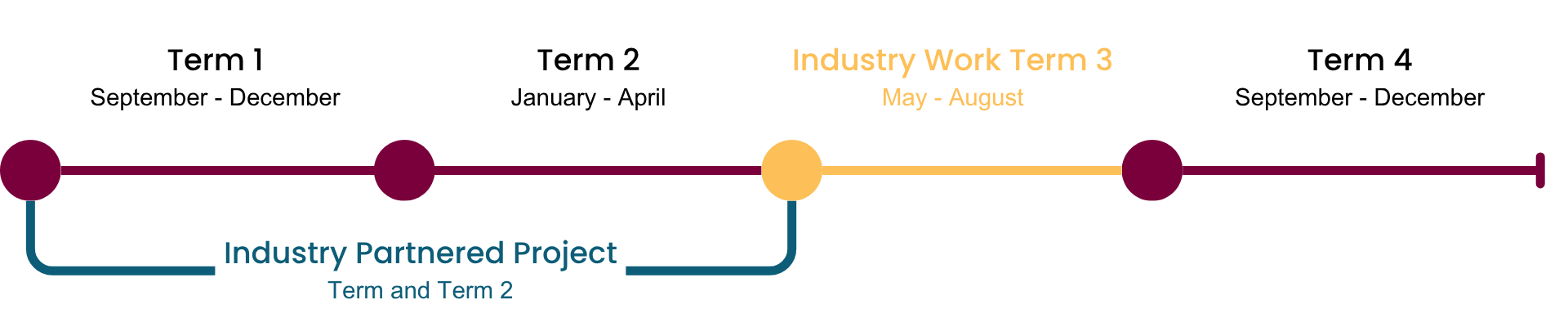
The Master of Management in AI and Analytics is a 16-month, full-time graduate program at McMaster’s DeGroote School of Business. Designed to bridge the gap between data science and business strategy, the program combines advanced coursework with hands-on, experiential learning. Students benefit from a two-term Industry-Partnered Project and one-term work term, offering deep engagement with industry partners and real-world applications of AI and analytics in business settings. With the possibility of specialization and a curriculum infused with AI, the program equips graduates with the skills to lead in data-driven organizations.
Curriculum Highlights:
- 13-course structure delivered over three academic terms, balancing foundational knowledge with advanced applications
- Hands-on learning with tools such as Python, R, SQL, Tableau and cloud-based platforms
- Access to both an eight-month Industry-Partnered Project and a mandatory four-month industry work term, where you’ll apply AI and analytics solutions to real business problems
- Focus on applied AI and analytics including model development, data storytelling and ethical decision-making
- Specialization and capstone work in your final term to explore emerging technologies and personalize your learning path
Graduates of the program will be able to logically approach and build conceptual analytics models to support organizational, customer, and business decision-making and effectively communicate their insights with strong critical thinking and presentation skills. They will skillfully apply AI and analytics tools across diverse functional areas and industries, while thoughtfully evaluating the ethical, social and cultural implications of these technologies in business contexts. Additionally, they will demonstrate a solid understanding of applied AI and analytics tools and programming languages, enabling them to assess emerging developments in the field and apply AI strategically within business environments.
McMaster academic calendar
Schedule breakdown
This program features a 13-course curriculum including an 8-month Industry-Partnered Project that is spread across two academic terms, and is complemented with a four-month work term—blending academic depth with practical, hands-on learning.
Courses
Terms 1 and 2
- Evaluating and planning for work term and new grad opportunities including career exploration and decision-making.
- Creating a personalized portfolio and developing strategies for professional development and skills acquisition.
- Maximizing success and learning during their work term through professional development.
Students will be exposed to ethical dilemmas and legal considerations related to job searches, as well as best practices for stress management during job searching. Students will gain clarity regarding the alignment between values, interests and motivators in relation to their career, and be empowered to play an active role in shaping their career path. The overall goal of this course it to help students gain self-awareness, skills, knowledge and confidence in relation to employment and their career goals.
During Terms I and II, students will participate in a two-phase Industry-Partnered Project, working in small teams of three to four. The Project follows McMaster University’s inquiry-based learning model, where students identify real-world problems, apply relevant tools and knowledge and present viable solutions.
Phase I: Discovery & Foundation
In Phase I, students are grouped based on their interests in applying analytics within a specific industry or sector. With support from a faculty instructor, each team connects with an industry partner to identify a real-world managerial challenge and establish parameters for data collection. Meetings with partners may take place in person or virtually, depending on availability and accessibility.
To prepare for the applied work ahead, students also complete a research methods module, covering:
- Effective use of academic and industry search engines
- Identifying, evaluating, citing and incorporating sources
- Organizing and synthesizing research findings
Additionally, Phase I includes opportunities to refresh key technical skills in tools, programming and techniques essential for analytics and applied AI.
Phase II: Application & Analysis
In Phase II, students deepen their research by identifying relevant datasets and selecting appropriate analytics tools and methodologies. Using these, teams analyze the data and generate evidence-based solutions.
The final deliverable includes a presentation of findings to instructors and industry partners, followed by collaborative feedback sessions.
Real-World Impact, Career-Ready Skills
The Industry-Partnered Project is designed to help students bridge theory and practice, while developing critical skills for careers in analytics-driven fields. Students will strengthen:
- Mathematical and computer modeling capabilities
- Tool and algorithm selection for problem-solving
- Data analysis and interpretation
- Communication and collaboration with industry professionals
By the end of the Project, students will be equipped to tackle complex problems with confidence, insight and a well-rounded professional toolkit.
This course will focus on the role of AI and Analytics in driving organizational success by focusing on what to do, how to make it happen and how to lead. Areas of focus will include: the significance of data (AI and Analytics) in strategy development; defining and creating a culture of analytics; and leading and managing both organizational and individual change. The course will also highlight the importance of communication, teamwork and trust in both leading and implementing analytics projects.
Terms 1 and 2
- Evaluating and planning for work term and new grad opportunities including career exploration and decision-making.
- Creating a personalized portfolio and developing strategies for professional development and skills acquisition.
- Maximizing success and learning during their work term through professional development.
Students will be exposed to ethical dilemmas and legal considerations related to job searches, as well as best practices for stress management during job searching. Students will gain clarity regarding the alignment between values, interests and motivators in relation to their career, and be empowered to play an active role in shaping their career path. The overall goal of this course it to help students gain self-awareness, skills, knowledge and confidence in relation to employment and their career goals.
During Terms I and II, students will participate in a two-phase Industry-Partnered Project, working in small teams of three to four. The Project follows McMaster University’s inquiry-based learning model, where students identify real-world problems, apply relevant tools and knowledge and present viable solutions.
Phase I: Discovery & Foundation
In Phase I, students are grouped based on their interests in applying analytics within a specific industry or sector. With support from a faculty instructor, each team connects with an industry partner to identify a real-world managerial challenge and establish parameters for data collection. Meetings with partners may take place in person or virtually, depending on availability and accessibility.
To prepare for the applied work ahead, students also complete a research methods module, covering:
- Effective use of academic and industry search engines
- Identifying, evaluating, citing and incorporating sources
- Organizing and synthesizing research findings
Additionally, Phase I includes opportunities to refresh key technical skills in tools, programming and techniques essential for analytics and applied AI.
Phase II: Application & Analysis
In Phase II, students deepen their research by identifying relevant datasets and selecting appropriate analytics tools and methodologies. Using these, teams analyze the data and generate evidence-based solutions.
The final deliverable includes a presentation of findings to instructors and industry partners, followed by collaborative feedback sessions.
Real-World Impact, Career-Ready Skills
The Industry-Partnered Project is designed to help students bridge theory and practice, while developing critical skills for careers in analytics-driven fields. Students will strengthen:
- Mathematical and computer modeling capabilities
- Tool and algorithm selection for problem-solving
- Data analysis and interpretation
- Communication and collaboration with industry professionals
By the end of the Project, students will be equipped to tackle complex problems with confidence, insight and a well-rounded professional toolkit.
Three elective courses of your choice from a selection of business options:
- MMGMT 730 / Synthetic Consumer Analytics
- MMGMT 732 / Revenue and Pricing Analytics
- MMGMT 733 / People Analytics/HR Analytics
- MMGMT 734 / Procurement & Logistics Analytics
- MMGMT 735 / Operations & Supply Chain Analytics
- BUSINESS C755 / Analytics and Decision Making in Healthcare
- BUSINESS E714 / Business and Economic Forecasting
- BUSINESS F741 / Introduction to FinTech
- BUSINESS F743 / Big Data in Finance
- BUSINESS M731 / Marketing Research
- BUSINESS M733 / Marketing Analytics
- BUSINESS M734 / Strategic Marketing Analysis

Recognized by the Vector Institute
DeGroote’s Master of Management in Applied AI and Data-Driven Decision-Making (MAIDM) is formally recognized by the Vector Institute for Artificial Intelligence, Canada’s leading organization advancing AI research, talent and innovation. This recognition reinforces the program’s focus on applied AI, data-driven decision-making and current industry needs.
Students enrolled in the program with strong academic standing in their previous studies may be eligible to apply for Vector Institute Scholarships valued at $17,500.
Our program embeds real-world experience into the academic structure, helping students understand how AI and data drive decisions across industries and develop the skills to apply these technologies to meaningful business challenges.

Have any questions?
Our DeGroote team is here to support you every step of the way. If you have any questions or need help with your application, don’t hesitate to reach out.